
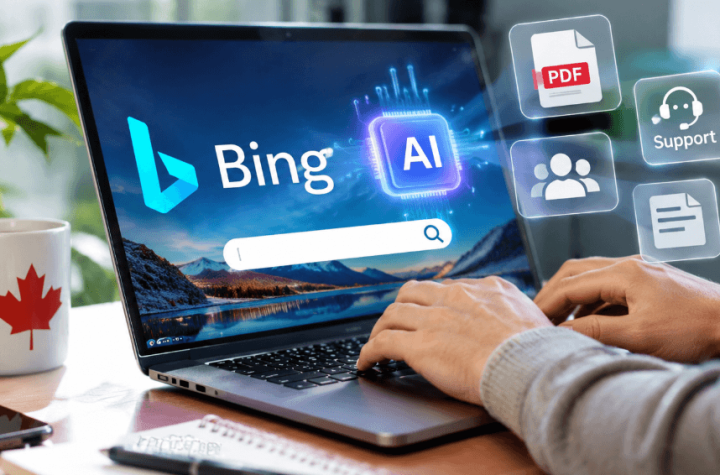
A comprehensive analysis of 883,313 artificial intelligence (AI) citations across 26 brands has revealed that Bing frequently references support documentation, PDF files, staff biographies and other informational resources rather than traditional blog posts and product pages.
The findings offer valuable insights for Canadian businesses, digital publishers and search engine optimization (SEO) professionals looking to improve their visibility across AI-powered search platforms.
Bing AI Citations Reveal Changing Content Preferences
Microsoft introduced the public preview of its AI Performance Reporting feature within Bing Webmaster Tools in February 2026, providing website operators with greater insight into how their content appears in AI-generated responses.
Researchers subsequently examined citation patterns across multiple industries to better understand which types of website content Bing’s AI systems reference.
The analysis found that blog posts, product pages and homepages collectively accounted for just 42 per cent of all citations examined.
The remaining 58 per cent came from a diverse range of resources, including mobile application pages, tourism attraction listings, instruction manuals, course catalogues, staff directories and PDF documents.
Application Pages and Tourism Resources Lead Citation Rankings
The most frequently cited URL in the dataset was an application page associated with a consumer product featuring an integrated mobile app.
A tourism organization’s attractions listing ranked second, highlighting the importance of practical, structured information that addresses specific user needs.
These findings suggest that organizations should consider the value of their entire website rather than concentrating exclusively on conventional content marketing strategies.
Microsoft Expands AI Performance Reporting Capabilities
Since introducing its AI reporting platform, Microsoft has expanded its capabilities to provide website administrators and SEO professionals with more detailed performance insights.
New features include query-to-page mapping, search intent and topic classifications, Citation Share and a beta version of Topics Portfolio.
Microsoft has also incorporated historical data into its reporting system, allowing researchers to revisit earlier findings and identify consistent citation trends.
The original research covered 15 brands. The expanded analysis included 26 organizations operating across nine industry sectors.
Study Examines More Than One Million AI Citations
The research included destination marketing organizations, hotels and resorts, e-commerce businesses, business-to-business manufacturers, post-secondary institutions, educational technology providers, regional healthcare organizations, government-related business services and a financial institution.
Researchers examined three reporting categories available through Bing Webmaster Tools: Grounding Queries, Cited Pages and Daily Overview.
The collected data included:
-
More than 1.1 million citations across all participating brands.
-
883,313 citations associated with 10,861 individual URLs.
-
Nearly 300,000 citations across 2,797 grounding queries.
-
Data from 26 brands representing nine industry sectors.
The study prioritized page-level reporting because it provided broader coverage and a more comprehensive understanding of the content referenced by Bing’s AI systems.
Grounding Queries Provide Limited Visibility
Grounding queries are search phrases generated by Microsoft’s AI systems to retrieve relevant information rather than the exact terms entered by users.
Microsoft explains that grounding query data “represents a sample of overall citation activity.”
Across the brands examined, grounding query exports accounted for between 5 and 39 per cent of total citations recorded in the overview reports.
By comparison, cited-page exports represented between 63 and 100 per cent of overall citation activity.
The researchers therefore relied primarily on page-level data when identifying broader patterns and content preferences.
Historical Data and Seasonal Trends Influence Analysis
The researchers avoided direct comparisons of raw citation totals between reporting periods because Microsoft had backfilled AI Performance data dating from June 1, 2026.
Microsoft’s Krishna Madhavan described the resulting increases as “just regular data backfilling” in a post on X.
Seasonal differences were also considered. Researchers retained findings that remained consistent across both spring and autumn reporting periods while excluding patterns potentially influenced by seasonal demand.
What the Findings Mean for Canadian Businesses and Publishers
For Canadian organizations, the study highlights the potential importance of maintaining accurate, accessible and well-organized information across their digital platforms.
Universities, tourism agencies, manufacturers, healthcare providers and retailers may benefit from reviewing frequently overlooked resources, including technical documentation, service directories, employee profiles and downloadable publications.
Traditional blog content remains an important component of digital marketing. However, the findings suggest that AI search visibility extends beyond conventional editorial and promotional material.
AI Search Visibility Extends Beyond Traditional SEO
The analysis demonstrates that Bing’s AI systems frequently reference practical and specialized website content. As AI-powered search continues to evolve, Canadian businesses and publishers may benefit from adopting a broader content strategy that prioritizes useful, reliable and accessible information throughout their websites.



More Stories
Uri Poliavich: Professional Adaptability for a Digital Environment
Cloudflare Plans Free Public Certificate Authority for Quantum-Safe TLS
Cloudflare behebt kritische Sicherheitslücke, die Kundendaten in gemeinsam genutzten Containern offenlegte