

Air France is investing approximately $1 billion in luxury travel upgrades, introducing private airport entrances, spa-equipped lounges and exclusive onboard suites as airlines increasingly compete for high-spending passengers amid rising fuel costs and pressure on economy-class demand.
The French carrier is expanding its premium services through its La Première first-class offering, aiming to deliver an experience comparable to private aviation while maintaining the convenience of commercial flights.
Air France Expands Luxury Travel With Private Airport Services
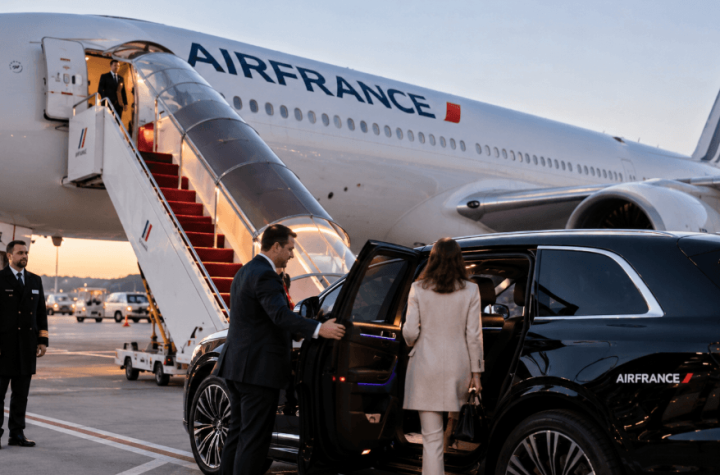
At Paris Charles de Gaulle Airport, select Air France first-class passengers are transported directly to their aircraft in a Porsche Cayenne, bypassing many of the procedures associated with conventional air travel.
La Première customers also receive access to dedicated airport entrances, discreet security screening and private lounges featuring spa facilities, champagne and caviar.
Once aboard, passengers can relax in spacious private suites, wear designer pajamas and enjoy meals developed by Michelin-starred chefs.
“We really wanted to move upmarket,” Air France’s Executive Vice President Customer Fabien Pelous told Reuters on board the plane.
“Over the past five years, we have created this new cabin and we have paid attention to every detail to push it to the maximum of the expectations of our customers,” Pelous said. “We wanted to create the space like in a private jet.”
Billion-Dollar Investment Targets Premium Passengers
Air France has allocated approximately €1 billion toward improvements in airport lounges, aircraft cabins and onboard Wi-Fi over five years.
The airline is also spending another €1 billion annually on fleet renewal, according to Pelous.
A round-trip La Première ticket between Paris and New York starts at just under $14,000, positioning the service among the most expensive commercial airline offerings.
“We did invest a lot of money both on the ground and in the air,” Air France Chief Executive Ben Smith told Reuters. “This particular cabin or class is unmatched.”
Air France was named the world’s best first-class airline at the 2026 Skytrax World Airline Awards.
Airlines Shift Toward Wealthier Travelers as Costs Rise
The investment reflects a broader aviation industry trend in which airlines are expanding premium seating while facing weaker demand from price-sensitive travelers.
Rising fuel expenses, inflation and economic uncertainty have made affordable travel more challenging for many consumers.
According to the International Air Transport Association, global passenger traffic growth is expected to slow to 2.1% in 2026, compared with 5.3% in 2025.
Air France reported that its combined first- and business-class segment grew 28.1% in 2025 and 26.9% in 2024, while economy-class revenue remained stagnant.
Aviation analyst John Strickland said carriers are increasingly willing to sacrifice total seat capacity to accommodate more premium passengers.
“The challenge is, of course, if you invest that much and you cut capacity and things do go sour, you can’t undo it,” Strickland said.
U.S. Airlines Also Expand Premium Travel Options
The shift extends across the American aviation market.
Traditionally budget-focused carriers, including Southwest Airlines, Frontier Airlines, JetBlue and Allegiant, are introducing or expanding higher-end travel options.
Delta Air Lines has similarly emphasized affluent customers, reflecting what economists describe as a K-shaped economy, where higher-income households continue gaining wealth while lower-income consumers face increasing financial pressure.
International competitors are making comparable investments.
British Airways is redesigning its Airbus A380 cabins to prioritize premium travelers, while Air India has introduced upgraded cabins on selected international routes.
LATAM Airlines Group Chief Executive Roberto Alvo has suggested that carriers with strong premium offerings could be better positioned to withstand economic turbulence.
“They will have a rougher time, we will see consolidation because of that,” Alvo said, referring to budget airlines.
Luxury Aviation Raises Environmental and Economic Questions
The expansion of first-class services also raises environmental concerns.
Premium passengers generally occupy considerably more cabin space than economy travelers, increasing their share of emissions per passenger. However, commercial first-class travel typically has a lower individual carbon footprint than flying on a private jet.
Air France argues that its premium offering provides another advantage: privacy.
Celebrities and other high-profile passengers can travel more discreetly on commercial aircraft, while privately registered jets may be monitored through publicly accessible flight-tracking services.
Meanwhile, the conflict involving the United States, Israel and Iran has contributed to sharp increases in energy prices, further complicating airline operations.
Jet fuel, which represents approximately 30% to 40% of airline operating expenses, has more than doubled in price since the beginning of 2026.
“The first impact of this war is a huge increase in the cost of petrol that definitely affects us,” Pelous said. “But despite this complicated context, we want to maintain our strategy to move upmarket.”
Premium Travel Remains Central to Airline Growth Strategies
Despite rising operating costs and uncertainty surrounding consumer spending, Air France remains committed to expanding its luxury services.
The strategy highlights a growing divide in commercial aviation, with airlines competing aggressively for wealthy travelers while economy passengers face higher fares and tighter budgets.
For Air France and its competitors, the long-term success of premium investments will depend on whether demand from affluent passengers remains strong enough to justify the substantial costs.



More Stories
Saint John Residents Raise Concerns Over Prospect of Second Large-Scale Data Centre
Volkswagen subsidiary delays opening of $7B St. Thomas battery plant to 2029
Calgary Launches New 500-Series Express Bus Network