

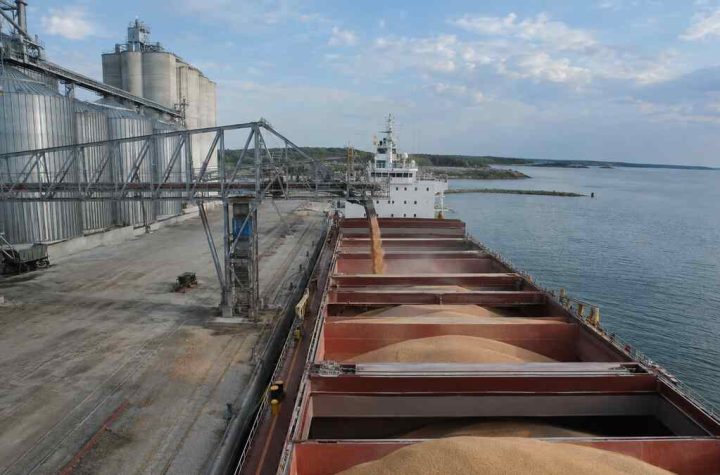
A vessel carrying Canadian wheat is scheduled to depart the Port of Churchill this week, marking the northern Manitoba facility’s first grain shipment since 2020 and renewing its role as a trade gateway between the Prairies and international markets.
The ship will carry approximately 30,000 tonnes of wheat to Antwerp, Belgium. Government and industry officials described the departure as a major milestone for the Hudson Bay port following years of infrastructure work and interruptions caused by the COVID-19 pandemic.
Churchill Reclaims Role as Northern Trade Gateway
“What we’re witnessing is the return of Churchill as a vital northern gateway connecting the Prairies, the Arctic to the rest of the world,” Northern Affairs Minister and Churchill—Keewatinook Aski MP Rebecca Chartrand said during a ceremony at the port Monday.
Churchill is Canada’s only deep-water Arctic port connected to the national rail network. Its location provides Prairie producers with an alternative route to Europe and other overseas markets.
Grain exports from the facility stopped during the pandemic, with the previous shipment departing in 2020. Port owner Arctic Gateway Group, which also controls the Hudson Bay Railway, announced in July that grain service would return this summer.
The wheat shipment is one of three planned grain departures this season through a partnership with Saskatchewan-based pulse and grain company AGT Foods.
Trade Diversification Becomes National Priority
The renewed activity comes as Canada seeks to reduce its economic reliance on the United States and expand access to global markets.
“The U.S. has fundamentally altered its trading relationships, and its demands of Canada have gone way too far,” Chartrand said.
“We’re building strength at home, we’re investing in Canadian infrastructure and expanding trade so that our economy is not dependent on any single market.”
The port’s traditional shipping season lasts about four months because of ice conditions in Hudson Bay. However, studies commissioned by Arctic Gateway and released earlier this month suggested that year-round operations could become feasible as sea-ice conditions change, potentially without relying on the most expensive classes of icebreakers.
Any extension of the season would require further examination of safety, infrastructure, environmental effects and operating costs.
Potash, Zinc and Nunavut Supplies Expand Port Activity
Arctic Gateway expects Churchill to record its most diversified shipping season to date. Along with grain, a vessel is loading zinc concentrate, while the port is preparing to handle its first potash shipment.
A northern resupply vessel bound for Nunavut is also being loaded, highlighting Churchill’s importance to remote Arctic communities that depend on seasonal marine deliveries.
Arctic Gateway is owned by a consortium of northern Manitoba and First Nations communities. The organization acquired the port and railway after years of uncertainty under former owner OmniTRAX, a Denver-based company that closed the port in 2016 as the railway deteriorated.
“This was an asset that had been neglected for decades, ironically by American interest,” Arctic Gateway CEO Chris Avery said.
Shipping resumed in 2019 after the consortium assumed control, but the pandemic halted grain movements again the following year.
“[We] had the foresight to say ‘Enough is enough … we’re going to take control of this infrastructure … as Canadians and as northern Manitobans and as First Nations,’” Avery said. “And what great foresight that was.”
Increased Shipping Raises Environmental Questions
The prospect of heavier vessel traffic and a longer operating season has prompted concerns about possible effects on wildlife and the sensitive Hudson Bay ecosystem.
Churchill resident Katie deMeulles said further research is needed before shipping activity expands significantly. As a Métis resident, she said the port’s Indigenous ownership gives her some confidence that environmental protection will remain part of future decisions.
“I’m not in for it being … a great big shipping hub,” she said. “But I think this could be a very [beneficial] thing for all of Canada, if we find some balance.”
The return of grain exports represents a significant step in Churchill’s recovery. Its long-term success, however, will depend on balancing trade diversification and northern economic development with the protection of local communities and the Arctic environment.



More Stories
Cuba Launches Power Restoration After Third Nationwide Grid Collapse in a Month
Sportswear: Lolle acquires Louis Garneau Sports
REM is still innovative enough to foot the bill